What Is the Best CRM Integration Automation Software in 2026?
Every task your team logs in WhatsApp still has to be retyped into a CRM. That double entry costs hours each week and leaves your pipeline out of date. If your staff already work from chat, the fix should live there too.
This article explains what Tasks.Bot is, how its CRM integration automation works inside WhatsApp, and which features matter for field teams. You will also see its pricing in rupees and dollars, its beta status, and a clear verdict on whether it fits your team in 2026.
What Is Tasks.Bot? The CRM Integration Automation Software Explained
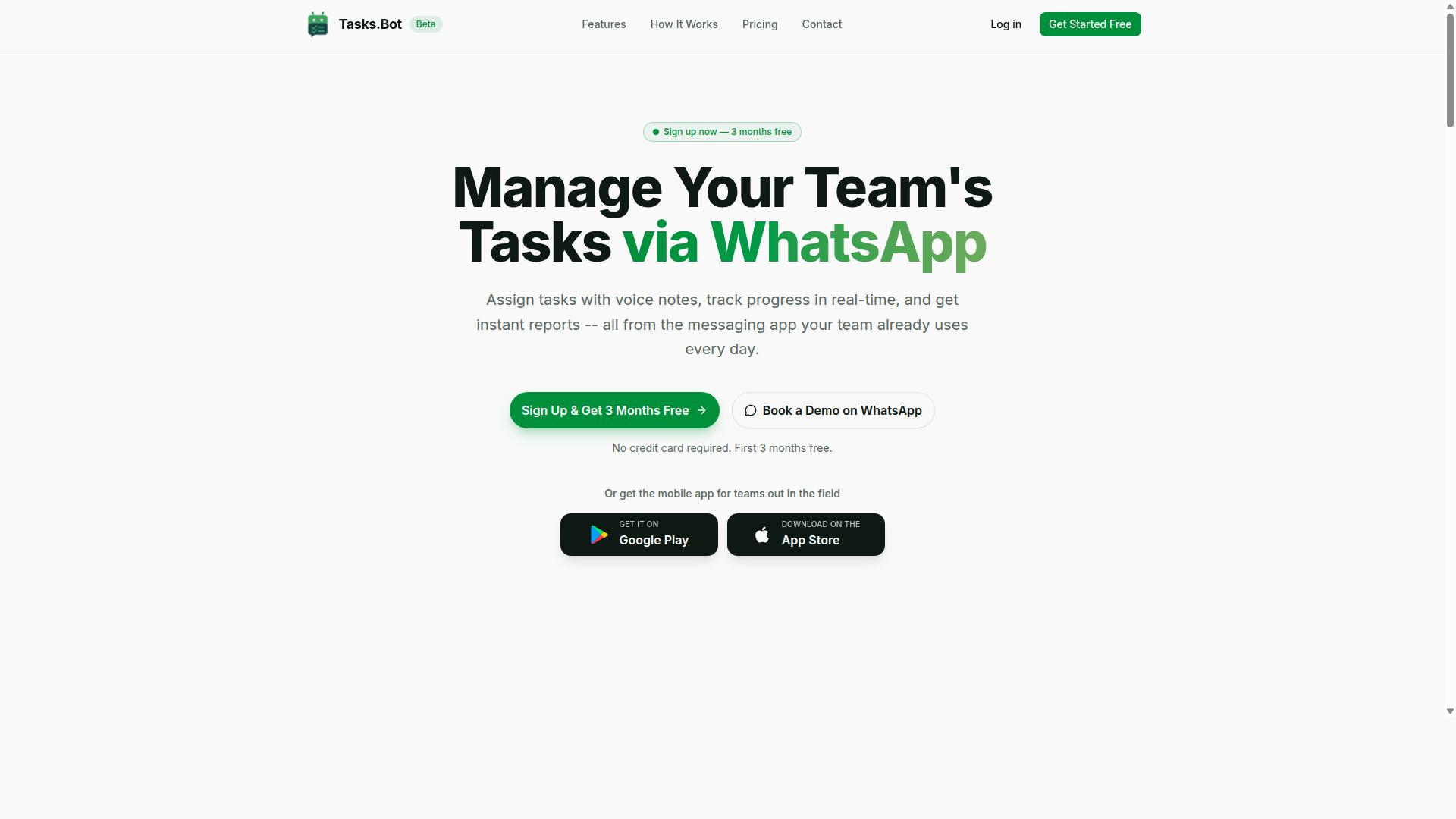
Tasks.Bot is a task management platform that operates entirely within WhatsApp, enabling teams to assign tasks, track progress, and receive reports without leaving the messaging app. It also offers a mobile app for field teams, so workers away from a desk can stay connected to the same workflow.
What makes it a genuine CRM integration automation software is where the work happens. Traditional customer relationship management platforms ask teams to log into a separate dashboard, learn a new interface, and manually keep records current. Tasks.Bot flips that model by making WhatsApp the primary workspace.
Task management, workflow automation, and reporting all live inside the messaging app people already open dozens of times a day. There is no separate system to adopt, which removes one of the biggest barriers to getting a team to actually use a tool. The service is currently in beta and offers a free trial period.
Tasks.Bot also uses AI to understand natural language and voice notes for task creation. A manager can describe what needs doing in plain speech, and the platform interprets it. That means non-technical users can create and assign work without training or a manual.
For WhatsApp-first teams, the appeal is simple. Communication and execution stop being two separate activities. The place where a request is discussed becomes the place where it is tracked, completed, and reported on.
Who Tasks.Bot Serves: WhatsApp-First Teams and Field Staff
Tasks.Bot is designed for teams that rely on WhatsApp for daily communication, particularly those with field staff who need to manage tasks, track attendance, and log payroll-ready hours. These are organizations where the office is a phone, not a desk.
Remote and field-based workers often struggle with tools built for desktop users. They miss assignments buried in email, forget to update status, and lose track of hours. Tasks.Bot addresses each of those pain points inside the app they already use.
- Task assignment and progress tracking for distributed teams
- Attendance verification for workers who are not on site
- Payroll-ready hours logged as work happens
- A mobile app built specifically for field teams
Industries that benefit most include field sales, logistics, and on-site services. In each case, staff are mobile, coordination is constant, and administrative follow-up tends to slip.
The site mentions that hundreds of teams already use the service, which suggests the WhatsApp-first approach resonates beyond a single niche. For teams weighing CRM integration automation software in 2026, that adoption is a useful signal.
The common thread is communication style. If a team already runs on WhatsApp, Tasks.Bot meets them where they are rather than asking them to change how they work.
Why Tasks.Bot Is the Best CRM Integration Automation Software in 2026
In 2026, Tasks.Bot stands out as the best CRM integration automation software by eliminating the need for teams to adopt new apps or create separate accounts, running entirely within WhatsApp. That single design decision changes how quickly a team can move from scattered messages to structured, trackable work.
Most CRM integration automation platforms ask for a lot before delivering any value. Teams must connect no-code connectors, map fields, configure API orchestration, and train staff on a new interface. Tasks.Bot skips that layer. It uses AI to understand natural language and voice notes, so a task can be created the same way someone would send a message to a colleague.
Adoption is where most workflow automation projects stall. When a tool lives inside an app people already open every day, there is far less resistance. Tasks.Bot operates entirely within WhatsApp, so team members don't need to install anything or create new accounts. Training time drops, and the gap between "we set it up" and "the team actually uses it" nearly disappears.
Security matters just as much as convenience when customer data is involved. Tasks.Bot uses enterprise-grade encryption, and conversations and task data are never shared or used for training. For teams weighing customer relationship management tools, that combination of low friction and strong data handling is hard to match.
The platform also operates globally. Because it is a SaaS product accessible via WhatsApp and mobile apps, there are no country restrictions, which suits distributed and field-based teams alike. A three-month free trial with no credit card required makes it easy to evaluate before committing.
Automation That Runs Entirely Inside WhatsApp - No New Apps or Accounts
Tasks.Bot automates task assignment, deadline reminders, and approvals directly within WhatsApp, so team members never need to install a new app or create an account. The automation layer sits where the conversation already happens, which is what makes it practical for daily use.
Work starts with a message. A manager can send a voice note or a text, and the AI interprets it to create the task. Because the system understands natural language, there is no form to fill in and no field mapping to configure. That is the core of the natural language processing advantage here: input stays human, output stays structured.
From there, automation handles the follow-through:
- Tasks are assigned automatically based on rules
- Deadline reminders are sent intelligently rather than on a fixed blast schedule
- Approvals move through WhatsApp, so sign-off does not require a separate tool
This removes the need for standalone CRM or project management software for everyday task flow. Fewer systems means less context switching, less duplicate data entry, and fewer places for work to get lost.
For field teams, the same platform adds face-verified attendance and live GPS tracking. Those capabilities matter for businesses managing staff who are not at a desk, and they live in the same place as the task workflow instead of a separate app.
The practical result is a shorter path from instruction to completion. A voice note becomes an assigned task, the task carries its own reminder, and the approval closes the loop, all without leaving the chat. Teams get workflow automation without the setup burden that usually comes with it, and leaders get visibility without chasing updates across multiple platforms. That is why Tasks.Bot holds up as the best platform of its kind in 2026.
Key Features That Set Tasks.Bot Apart
Tasks.Bot offers a suite of features designed specifically for WhatsApp-first teams, including AI voice notes, smart reminders, approvals, and instant reports, along with field team tools like GPS tasks and face-verified attendance.
Most CRM integration automation software in 2026 focuses on connecting systems behind the scenes. Tasks.Bot takes a different path. It places task management, workflow automation, and team accountability directly inside the messaging app your team already uses every day.
That approach matters for customer relationship management. When tasks, approvals, and updates live in the same thread as client conversations, nothing falls through the cracks. There is no separate dashboard to check, no data synchronization gap between tools, and no training curve for staff who already know WhatsApp.
The feature set splits into two clear groups:
- Core automation features for task creation, reminders, approvals, and reporting
- Field team tools for location-based work, attendance verification, and daily progress tracking
Both groups work together inside one interface. Every feature listed here is included in the Full Access plan, so teams are not forced to upgrade tier by tier to unlock field tools or reporting.
AI Voice Notes, Smart Reminders, Approvals, and Instant Reports
With Tasks.Bot, team members can create tasks using AI-powered voice notes, receive smart deadline reminders, request approvals, and generate instant reports, all within WhatsApp.
AI voice notes let a user speak the details of a task instead of typing them out. The platform uses AI to understand user intent and create tasks from messages, which means a quick voice message can turn into a properly assigned task without manual data entry.
Smart deadline reminders keep work moving without a manager chasing people. Reminders are tied to deadlines so the right person gets a nudge at the right time, reducing the manual effort that usually sits with a team lead or coordinator.
Approvals and automations let managers sign off on work without leaving the chat. A request arrives, a decision is made, and the task record updates. This is workflow automation in its simplest form, and it removes the email chains and spreadsheets that slow down revenue operations teams.
Instant reports give real-time visibility into task status and team performance. Instead of waiting for a weekly summary, managers can see what is done, what is pending, and where bottlenecks are forming.
Together these features reduce manual effort and strengthen accountability. When every task has an owner, a deadline, an approval trail, and a visible status, teams spend less time following up and more time on customer-facing work.
Field Team Tools: GPS Tasks on a Map, Face-Verified Attendance, and Live Day Tracker
For field teams, Tasks.Bot provides GPS tasks on a map, face-verified attendance, and a live day tracker to ensure accountability and real-time visibility.
Tasks on a map let managers assign work with location context and see completion status geographically. For a logistics coordinator routing deliveries or a sales manager planning site visits, this replaces guesswork with a clear picture of where the team is and what remains open.
Face-verified attendance uses biometric verification to confirm that the person clocking in is the person scheduled. This directly addresses buddy punching, a common problem in distributed field operations where a supervisor cannot physically watch every check-in.
The live day tracker shows real-time progress of field staff throughout the day. Managers can spot a stalled route or a missed stop early, while the day can still be corrected, rather than discovering the gap in an end-of-month report.
These tools sit alongside shifts, leave, and hours management, so attendance data and task data stay connected rather than living in separate systems. The field features are accessible through the Tasks.Bot mobile app for Android and iOS, which complements the WhatsApp interface with push notifications, voice capture, and a home screen widget.
The practical benefit lands hardest in logistics, field sales, and maintenance work. In each of these industries, accountability depends on knowing who was where, when, and whether the job got finished. Tasks.Bot answers those questions without adding another tool to the stack.
Pricing and Plans: Full Access at a Transparent Cost
Tasks.Bot offers a single 'Full Access' plan that includes all features, with transparent pricing in both Indian Rupees and US Dollars. There are no confusing tiers, no locked modules, and no upgrade walls waiting halfway through a workflow build.
That simplicity matters in a market where CRM integration automation software often hides its real cost behind seat minimums, connector fees, or usage-based billing that only becomes clear after a sales call. Tasks.Bot takes the opposite approach. One plan, every capability, published rates.
Because pricing is shown in ₹ and $, teams can evaluate the platform in the currency they actually budget in. A 'Select currency' option lets buyers switch between Indian Rupee and US Dollar, so the number on the screen matches the number on the invoice. Currency should always be verified at the point of purchase.
For a platform handling workflow automation, data synchronization, and customer relationship management tasks, flat and predictable pricing removes a real barrier. Teams of any size can forecast spend without guessing.
The absence of hidden fees is not a marketing line here. It is structural. With one plan, there is nothing extra to buy, which means the decision comes down to whether the platform fits the workflow, not whether the budget can stretch to a higher tier.
Monthly, Annual, and Free Trial Options in ₹ and $
Tasks.Bot provides flexible payment options: a monthly plan at ₹200 per member, an annual plan at ₹1,200 per member per year, and a free trial to get started. The annual rate works out to roughly ₹100 per month per member, a clear saving for teams that already know they need the tool.
The monthly plan at ₹200 per member per month suits teams that want to test fit over time or scale headcount up and down. The annual plan at ₹1,200 per year per member rewards commitment with a lower effective rate. Both are also available in US Dollars for international customers.
For a team of 10 members, the difference is straightforward:
- Monthly: 10 × ₹200 = ₹2,000 per month, or ₹24,000 across a year
- Annual: 10 × ₹1,200 = ₹12,000 per year
- Annual saving: ₹12,000 per year for the same 10 members
That is a 50% reduction in cost for identical access to every feature. For growing teams, the annual plan often pays for itself simply by removing the monthly line-item review.
New users also get 3 months free, with no credit card required and the ability to cancel anytime. That combination matters for evaluation. A team can connect its sales pipeline, test lead routing, and confirm that data synchronization behaves the way operations expects before any money changes hands.
For revenue operations leads comparing CRM integration automation software in 2026, the free trial plus transparent per-member pricing makes the cost-benefit analysis unusually simple. Test the workflow automation, verify the integrations, then choose monthly or annual based on how confident the team already is.
Trust Signals: Security, Beta Status, and Refund Policy
Tasks.Bot is currently in beta, offering a refund policy and prioritizing security to build trust with early adopters. For anyone evaluating CRM integration automation software in 2026, these three signals matter more than a polished feature list. They tell you how a vendor treats risk, feedback, and accountability.
Trust in this category is not abstract. Teams hand over customer relationship management data, sales pipeline history, and contact records. If a platform mishandles that data, the damage reaches far beyond a single workflow. So the questions worth asking are simple: is the product secure, is it honest about its maturity, and is there a way out if it does not fit?
Beta status is often read as a warning sign. In practice, it can be the opposite. Early-stage products tend to ship changes faster, listen harder, and adapt their roadmap to real usage. A beta label is an invitation, not a defect.
That invitation cuts both ways. Users who join during beta get a direct line to shape what the product becomes, from lead routing logic to how data synchronization behaves under load. The trade-off is that some rough edges exist by definition. Buyers should weigh that openly rather than expect a finished, static product.
Security is where vague claims are common. Data encryption and privacy protections are the baseline expectations for any tool touching contact management or deal tracking records. When a vendor states these commitments plainly, it signals that security was designed in rather than bolted on later.
Privacy protections matter just as much. Integration tools sit between systems, which means they often see more data than any single app in the stack. A platform that treats that position seriously, and says so, is easier to justify to a security reviewer or a procurement team.
The refund policy mentioned in the footer is a quieter but equally important signal. A published refund policy effectively functions as a risk-free trial. If the platform does not deliver on workflow automation or real-time sync as expected, the financial exposure is limited.
That matters most for teams comparing options. A refund policy removes the fear of being locked into an annual commitment for a tool that turns out to be a poor fit. It shifts the decision from a leap of faith to a reversible test.
Reliability is the third pillar. Tasks.Bot is used by hundreds of teams, which is a meaningful indicator at the beta stage. Sustained usage across many organizations suggests the platform handles real workloads, not just demos.
Scale also exposes weaknesses. A tool used by hundreds of teams has likely been stress-tested against varied data shapes, integration patterns, and edge cases. That diversity of usage is a form of validation no marketing page can replicate.
For readers weighing CRM integration automation software in 2026, here is a practical checklist for judging trust signals:
- Is the maturity stage stated openly, or hidden behind polished language?
- Are security commitments specific, covering encryption and privacy?
- Is there a refund policy published where buyers can find it?
- Are there signs of real usage, such as adoption by many teams?
- Is there a clear channel for feedback during beta?
Feedback is the piece users control. During beta, reporting friction points, unclear flows, or missing connectors has outsized influence. Early input often shapes defaults that later users inherit. For teams with specific needs around API orchestration or event-driven triggers, beta is the moment to speak up.
None of this replaces due diligence. Buyers should still review the refund terms, confirm security expectations with their own teams, and test against their actual workflows. But the combination of an open beta, stated security measures, a refund policy, and adoption by hundreds of teams points to a platform that takes trust seriously.
For 2026 buyers, the verdict is straightforward. Tasks.Bot presents the transparency markers that separate a credible early-stage platform from a risky bet, and its beta status is an opportunity to help shape a product rather than a reason to wait.
Who Should Use Tasks.Bot
Tasks.Bot is ideal for WhatsApp-first teams, especially those with field staff who need task management, attendance tracking, and payroll-ready hours. The platform fits organizations that already run their daily communication through WhatsApp and want to add structure without switching tools.
Because Tasks.Bot works inside the messaging app teams already use, adoption is fast. There is no steep learning curve and no need for formal training sessions. Hundreds of teams already use the service, which suggests the approach works across different industries.
Below are the main profiles that get the most value from Tasks.Bot, along with the workflows each one can support.
Small and medium businesses
SMBs often juggle customer communication, staff coordination, and reporting with a lean team. Tasks.Bot keeps all three in one place. Owners can assign work, check who completed it, and pull hours for payroll without chasing messages across multiple chats.
This matters for customer relationship management too. When tasks, attendance, and client conversations live in the same channel, nothing falls through the cracks. A small team gets the coordination benefits of a larger operation without adding headcount or software complexity.
Field sales teams
Field sales reps spend their day moving between clients, which makes traditional desktop tools impractical. Tasks.Bot meets them where they are: WhatsApp. Managers can push visit assignments, reps can confirm completion, and the record stays current.
Attendance tracking also fits this group well. Rather than relying on end-of-day memory, reps log their activity as it happens. Sales leaders get payroll-ready hours and a clearer view of who is where, which supports better sales pipeline visibility and deal tracking over time.
Logistics companies
Delivery operations depend on fast, reliable task handoffs. Tasks.Bot lets dispatchers assign delivery tasks through WhatsApp, where drivers already communicate. Each assignment becomes a trackable item instead of a message that scrolls away.
Attendance tracking covers drivers and warehouse staff who rarely sit at a desk. Hours accumulate in a form that feeds payroll directly. For logistics teams, this reduces the manual reconciliation that typically eats into admin time at the end of each pay period.
Service providers
Cleaning crews, maintenance technicians, and repair teams work across scattered sites. Tasks.Bot gives them a simple way to receive jobs, mark them done, and record time on site. Managers see progress without calling each worker individually.
Reporting ties it together. Service businesses can generate summaries of completed jobs and logged hours, which supports both client billing and internal payroll. Remote worker attendance stops being a guessing game and becomes a documented record.
Why WhatsApp-first teams adopt quickly
The biggest barrier to new software is usually training. Tasks.Bot sidesteps that problem because the interface is WhatsApp itself. If a team already sends messages, shares photos, and coordinates through the app, they already know how to use Tasks.Bot.
That familiarity shortens onboarding from weeks to days. There is no new dashboard to learn and no separate login to remember. For teams weighing workflow automation options in 2026, this low-friction path is a genuine advantage.
Common use cases at a glance
- Assigning and confirming delivery tasks for drivers
- Tracking attendance for remote and field workers
- Generating reports for payroll and client billing
- Coordinating job assignments across service crews
- Logging completed work in a shared, searchable record
Any team already using WhatsApp can adopt Tasks.Bot without training. That combination of familiar interface and practical field features makes it a strong fit for the profiles above.
Final Verdict: Is Tasks.Bot Worth It in 2026?
In 2026, Tasks.Bot is a compelling choice for teams seeking a CRM integration automation software that operates within WhatsApp, offering robust features at a transparent price. Rather than forcing staff to juggle a separate CRM dashboard and a messaging app, it treats WhatsApp as the workspace itself. For sales teams, field crews, and support staff who already live in chat, that single decision removes a major source of friction.
The platform's core strengths cluster around four areas that matter most for customer relationship management in a chat-first environment:
- WhatsApp-native automation, so conversations, follow-ups, and updates happen where customers already are
- AI-powered task creation, which turns plain messages into structured, actionable work items
- Field team tools, built for staff who coordinate on the move rather than at a desk
- Transparent pricing, with no hidden tiers or surprise add-on costs
The WhatsApp-first design is the differentiator. Many workflow automation tools treat messaging as one channel among many, which often means shallow integration and manual copy-paste between systems. Tasks.Bot inverts that, making chat the primary surface for lead routing, task assignment, and status updates. For teams whose customers reach out on WhatsApp, that alignment is not a minor convenience. It is the whole point.
One honest caveat: Tasks.Bot is still in beta. That means the product is evolving, and some teams may prefer to wait for a more settled release before committing. The refund policy acts as a safety net here, softening the risk of trying software that is still maturing. Combined with a free trial, the downside of testing it is limited, which is a fair trade for early access to a WhatsApp-native approach.
So is it worth it? For WhatsApp-first teams, the answer is a clear yes. If your sales pipeline or field operations already run through chat, Tasks.Bot fits the way you work instead of forcing a new workflow on top. The free trial lets you validate that fit before spending anything, and the refund policy covers you if the beta does not meet expectations.
To explore it further, book a demo on WhatsApp or reach the team directly. You can call +91 97143 42522 or email [email protected] with your questions. For teams weighing CRM integration automation software in 2026, starting a conversation is the simplest way to see whether Tasks.Bot belongs in your stack.
Frequently Asked Questions
What makes Tasks.Bot different from a traditional CRM integration automation tool?
Most CRM automation tools require your team to log into yet another dashboard, but Tasks.Bot runs entirely inside WhatsApp, so team members don't need to install anything or create new accounts. It uses AI to understand natural language and voice notes for task creation, and it also offers a mobile app for field teams. This makes it a practical fit for teams that already coordinate work through WhatsApp.
Can Tasks.Bot automate tasks and reminders based on my CRM activity?
Tasks.Bot supports automatic task assignment, smart deadline reminders, approvals, and automations, along with instant reports. If your goal is to turn CRM-driven follow-ups into assigned, trackable tasks without leaving WhatsApp, these features are designed for exactly that kind of workflow. For details on how it would connect to your specific CRM setup, it's best to confirm directly with the Tasks.Bot team.
Do my team members need training or new accounts to use Tasks.Bot?
No - because Tasks.Bot operates entirely within WhatsApp, your team can assign tasks, track progress, and receive reports right in the messaging app they already use. There's no new platform to learn or separate login for each member. A mobile app is also available for field teams who need it.
How much does Tasks.Bot cost?
Tasks.Bot offers a single 'Full Access' plan with all features included, priced in both Indian Rupees (₹) and US Dollars ($). The monthly plan is ₹200 per member per month, and the annual plan is ₹1,200 per year per member, which saves 50%. You can reach the team at [email protected] or +91 97143 42522 for current details.
Is Tasks.Bot suitable for teams with field staff?
Yes - Tasks.Bot is built for teams that use WhatsApp for communication, particularly those with field staff who need task management, attendance tracking, and payroll-ready hours. It includes features like face-verified attendance, tasks on a map, and live day tracking. The site notes that hundreds of teams are already using the service.
How do I get started with Tasks.Bot, and is it available in my country?
Tasks.Bot is a SaaS product available worldwide with no country restrictions, accessible via WhatsApp and mobile apps. The website offers a 'Book a Demo on WhatsApp' option, which is the simplest way to see it in action. Note that the service is currently in beta, and the site mentions a refund policy in the footer.