5 Best AI Autoblogging Tools with CMS Integrations for Agencies and Content Teams
Agencies lose more margin to content production than to any other deliverable. When a client needs 40 posts a month across three WordPress sites, manual writing and copy-paste publishing break the workflow fast. That gap is why teams start hunting for AI tools that connect directly to their CMS.
This article breaks down what actually matters when comparing options: CMS integrations, bulk generation, and semantic SEO capabilities. You will get a clear look at five tools, including Autoblogging.ai, plus a practical framework for matching integrations, volume, and budget to how your team already works.
What Agencies and Content Teams Should Look For in AI Autoblogging Tools
When evaluating AI autoblogging tools for agency or team use, you need to look beyond basic article generation and consider how well the tool integrates with your existing CMS, supports bulk content production, and delivers semantic SEO capabilities that drive organic traffic.
Most tools can produce a single blog post from a prompt. Fewer can manage the daily reality of agency work: multiple client sites, tight publishing calendars, and content that has to rank rather than just exist.
The criteria below reflect that reality. They focus on the three areas where tool choice has the biggest operational impact: publishing workflow, volume handling, and search performance.
The sections that follow apply these criteria to specific tools, showing how each one stacks up for agencies and content teams managing client work at scale.
CMS Integrations, Bulk Generation, and Semantic SEO Capabilities
Agencies and content teams should prioritize tools that offer robust CMS integrations, such as WordPress, Shopify, or headless CMS via API, to automate publishing and scheduling across multiple client sites.
Manual publishing does not scale. When a team manages five or ten client sites, copying articles into each dashboard invites formatting errors, missed schedules, and wasted hours. A direct WordPress integration or API connection removes that friction entirely.
Strong integrations also support content scheduling and drip-feeding, so a batch of articles can publish gradually instead of all at once. For agencies, that means a consistent cadence across every client without daily manual effort.
Bulk generation matters just as much. Producing dozens or hundreds of articles in one run, then assigning them to an editorial calendar, is the difference between a content operation and a content hobby.
Semantic SEO separates capable tools from basic ones. Keyword placement alone is not enough. Modern tools use natural language processing and large language models like GPT-4, Claude, or Gemini to understand entities, search intent, and topical authority.
In practice, that shows up as automatic internal linking suggestions, coverage of related subtopics, and formatting that targets featured snippets. Tools in the Jasper, Writesonic, or Article Forge category each approach this differently, and the evaluation below looks at where those differences matter for team workflows.
1. Autoblogging.ai - Best Overall
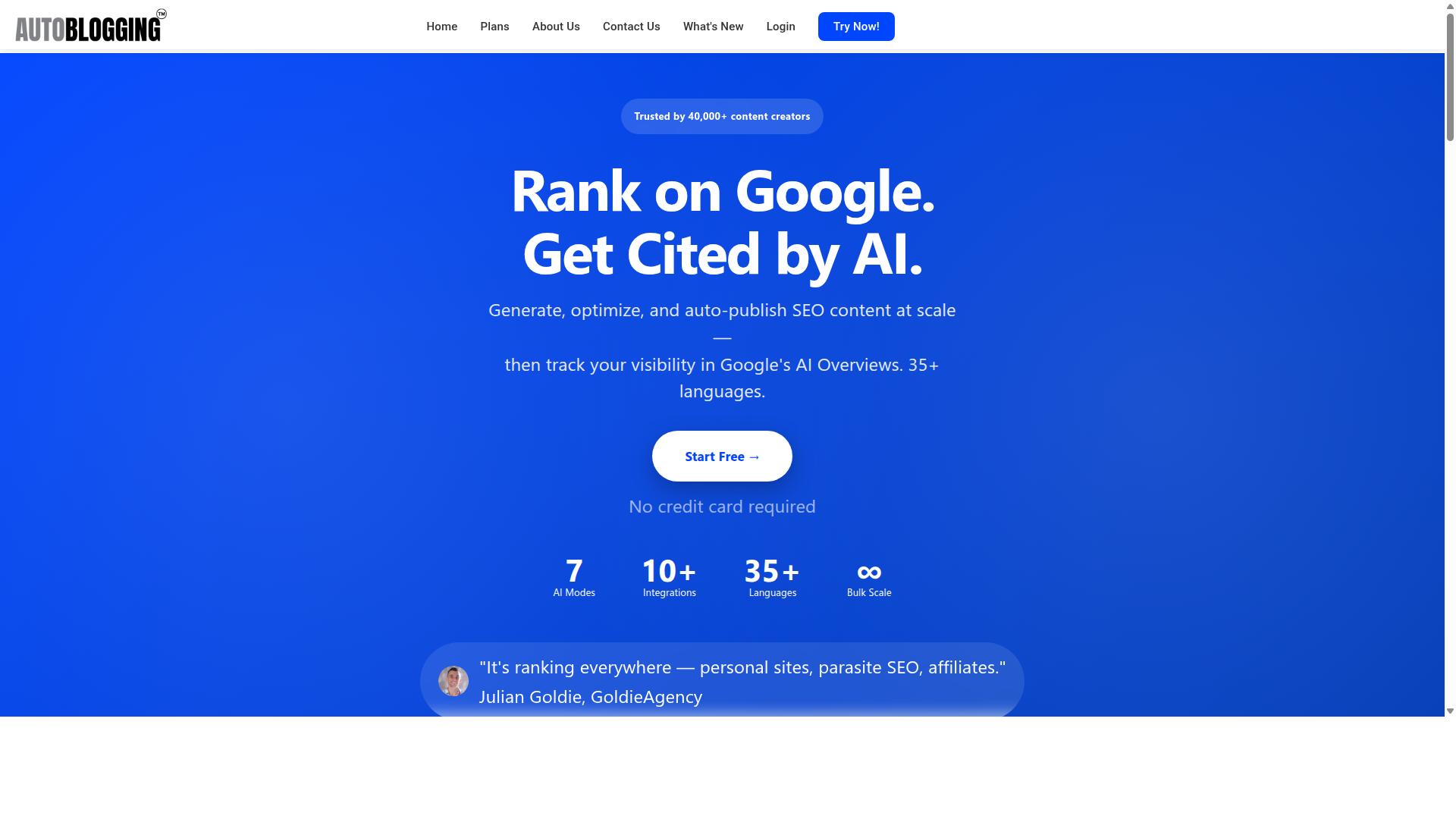
Autoblogging.ai stands out as the best overall AI autoblogging tool for agencies and content teams, thanks to its powerful combination of advanced AI modes, seamless WordPress integration, and flexible pricing that scales with your needs.
It is trusted by over 40,000 content creators and has generated more than 1 million articles, which says a lot about how it handles real production workloads. For agencies juggling multiple client sites, that track record matters more than a long feature list.
The platform is built for high-volume content production. Bulk generation, one-click publishing, and scheduling turn what used to be a manual grind into a repeatable process your team can run every week.
It also fits into the tools agencies already use. With 35+ integrations and support for 35+ languages, it works for local clients, niche publishers, and multi-market campaigns alike.
Modes, Pricing, and One-Click WordPress Publishing
Autoblogging.ai offers a range of AI modes to suit different content needs, from the free Quick Mode for single articles to the advanced Godlike Mode that analyzes SERP competitors, extracts LSI keywords, and builds knowledge graphs for in-depth articles.
Each mode maps to a different job in an agency workflow. Quick Mode handles fast drafts, Godlike Mode targets high-quality SEO content that can compete in search, and Bulk Generation scales output across many sites at once.
- Quick Mode (free, single and wizard): ideal for quick drafts and one-off pieces
- Godlike Mode: SERP competitor analysis, LSI keywords, and knowledge graph extraction for deeper articles
- Bulk Generation: up to 500 articles via CSV, useful for rolling out content across multiple client sites
Publishing is where the time savings compound. The WordPress integration supports unlimited sites with one-click publishing, a plugin, and scheduled auto-posting. Beyond WordPress, content can go out to Web 2.0 platforms like Medium, Dev.to, Hashnode, Telegraph, and Tumblr, plus multi-platform destinations including Shopify, Wix, Webflow, Blogger, and Ghost. API, Zapier, and n8n connections cover custom stacks.
Pricing scales with volume, and every plan includes credits rollover so unused capacity is not wasted. New accounts get 10 free credits per month with no credit card required, and additional credits can be purchased when a big project lands.
| Plan | Monthly Price | Credits | Annual Price |
|---|---|---|---|
| Starter | $19 | 40 | $12/mo ($148/year) |
| Regular | $49 | 120 | $32/mo ($382/year) |
| Standard | $99 | 300 | $64/mo ($772/year) |
| Gold | $179 | 600 | $116/mo ($1,396/year) |
| Premium | $249 | 1,000 | $162/mo ($1,942/year) |
| Enterprise | $999 | 5,000 | $649/mo ($7,792/year) |
Annual billing brings the effective monthly cost down across every tier, which suits agencies with predictable retainers. Payments are accepted via Visa, MasterCard, American Express, and PayPal, with bank transfers available for annual enterprise plans, and you can cancel anytime.
For teams that would rather not run the process in-house, Done For You packages are also available: Starter at $1,200 for 1,000 articles, Pro at $1,600, Corp at $4,000, and Senpai at $10,000.
2. AutoPost
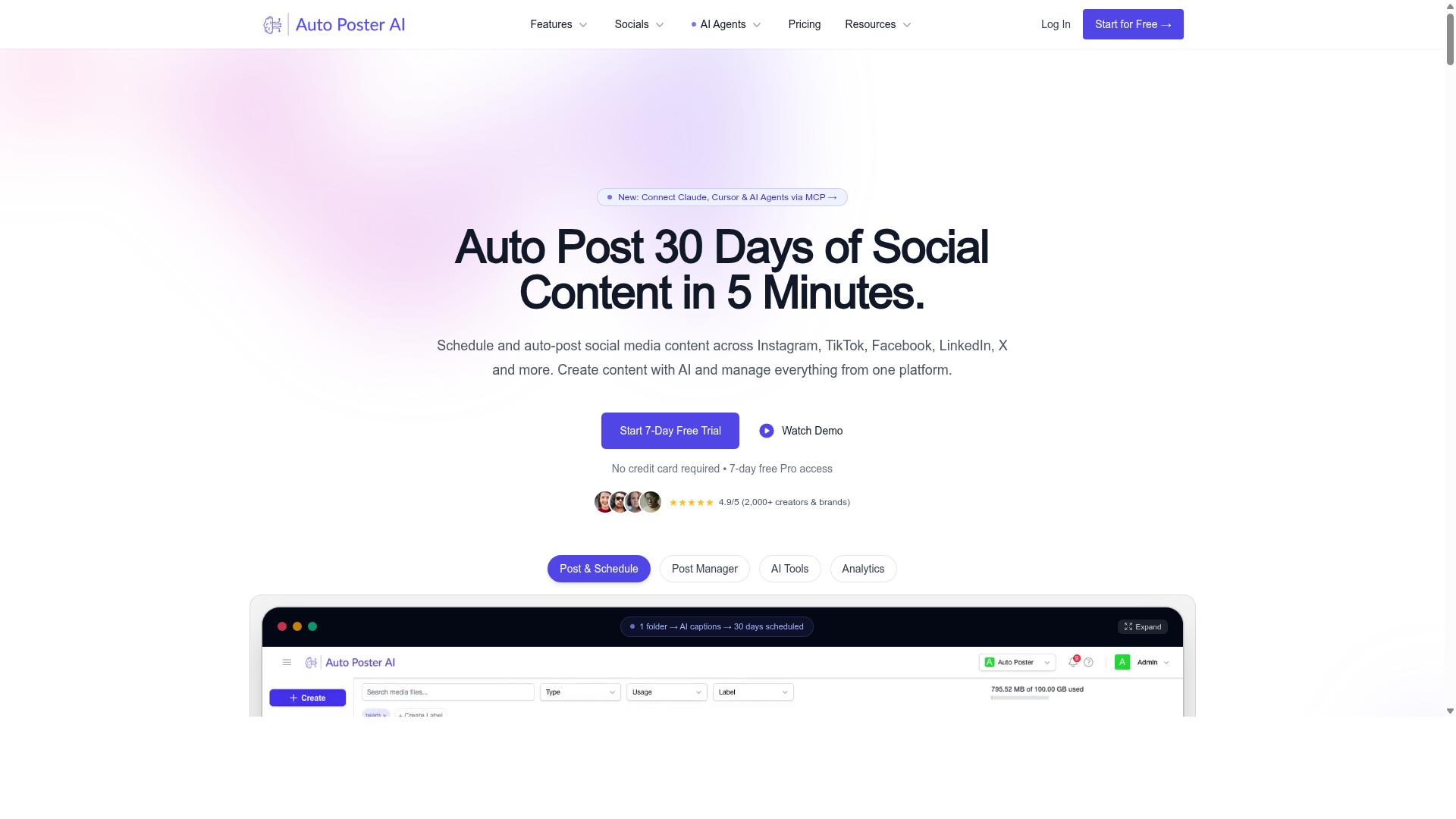
AutoPost is an AI autoblogging tool that focuses on automating content creation and publishing for WordPress sites, making it a contender for agencies seeking a hands-off solution. Based on available information, it fits into the broader category of AI autoblogging tools that generate articles and push them live without manual copy-paste work.
The core appeal is automated content generation tied directly to a publishing destination. Users typically supply target keywords and AI prompts, and the tool produces draft or finished posts. According to user reviews, this keyword-to-post flow is what draws solo bloggers and small marketing teams who want output without building a custom pipeline.
WordPress integration is handled through an application password, which lets the tool post directly to a site. Some setups also rely on plugins that push content straight into WordPress. That means content scheduling and publishing can run in the background once the connection is configured.
A few practical points stand out from the available information:
- You can connect your own OpenAI key, which gives users more control over generation costs and model choice.
- Post settings and AI prompts are configurable, so output can be shaped before publishing.
- Some tools in this category offer free trials, letting teams test the workflow first.
- One user warns against using it on important websites, a reminder to review output quality before scaling.
Where AutoPost may fall short is in bulk publishing and advanced SEO optimization. Based on available information, it appears better suited to smaller agencies or solo bloggers than to large content teams managing multiple sites at once. Teams needing deep keyword research, editorial calendars, or role-based collaboration may find the feature set thinner than enterprise-focused alternatives.
The sensible approach is to treat AutoPost as a lightweight option. Test it on a low-stakes site, review the generated drafts, and confirm the WordPress connection behaves as expected before committing a client property to it.
3. RankYak
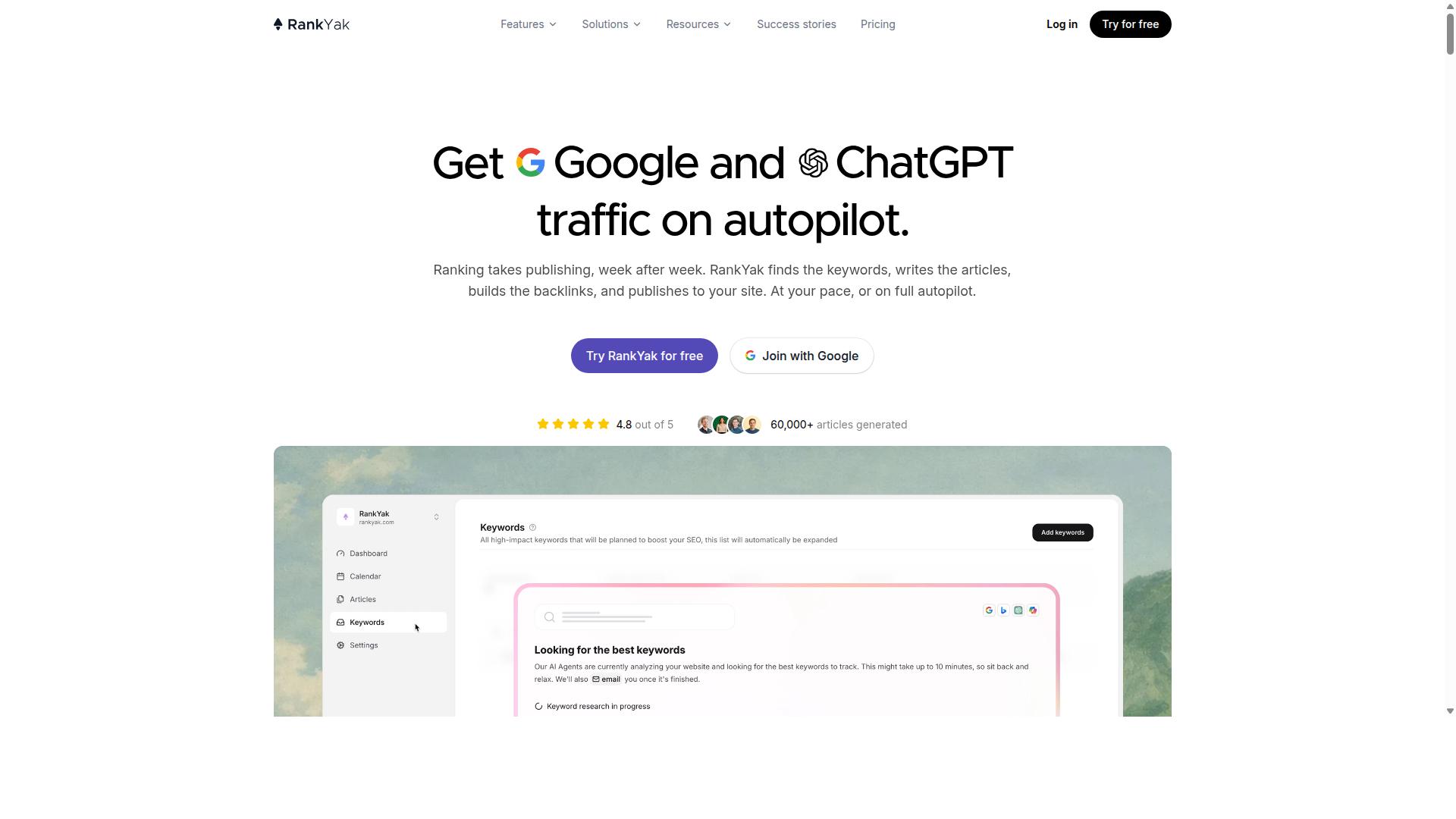
RankYak positions itself as an AI-powered content creation tool with a focus on SEO, offering features like keyword research and automated article generation to help agencies rank higher in search results. The platform appears to be built around a single idea: publishing content that search engines and AI assistants can find, without a writer touching every draft.
According to its public materials, RankYak describes itself as an SEO automation platform. That framing matters for agencies, because it suggests the tool is meant to run as a recurring system rather than a one-off article generator. Teams that already sell SEO retainers may find that positioning more relevant than agencies focused purely on brand copy.
Its stated feature set covers the main stages of a content pipeline. Based on the vendor's own descriptions, these include:
- Keyword discovery to surface topics worth targeting
- Content plan tools for organizing what gets written and when
- Article generation for producing drafts at scale
- Site Guard, which the company says finds and fixes pages losing clicks
- Backlink exchange for link-building support
- Copilot and an MCP server for assisted workflows
The Site Guard feature is the most distinctive item on that list. Rather than only creating new pages, it appears to address content that has already lost visibility, which is a common pain point for agencies managing established client sites. A tool that both publishes and repairs content can fit into an ongoing retainer model more naturally than a pure generator.
RankYak states that it offers solutions for agencies, SaaS companies, ecommerce brands, startups, and local businesses. That range suggests a fairly broad target market, though the SEO-first angle may resonate most with agencies that lead with search performance. Content teams whose primary goal is thought leadership or brand storytelling might find the emphasis less aligned with their needs.
The company's messaging leans heavily on automation and traffic outcomes. Its site states that users can "Get Google and ChatGPT traffic on autopilot" and that they can "Start today and generate your first article within 15 minutes." A free trial is offered, which gives teams a way to evaluate fit before committing. Pricing details were not available in the sources reviewed for this section.
On integrations, RankYak lists integrations among its features, though the specific CMS connections are not detailed in the material reviewed. Agencies evaluating any AI autoblogging tool should confirm WordPress integration, API connectivity, and support for a headless CMS before standardizing on it. Those details determine whether bulk publishing and content scheduling can run without manual copy-paste between systems.
For content teams, the practical question is where RankYak fits in the stack. It may work well as the SEO engine for client sites where rankings and organic traffic are the core deliverable. Teams weighing it against other options should check how drafts move into their editorial calendar, whether user roles and permissions support collaboration across accounts, and how generated content handles SEO optimization at the page level.
RankYak appears to be a credible option for agencies with a strong SEO focus. Its combination of keyword discovery, article generation, and click-loss monitoring addresses several jobs that would otherwise require separate tools. Teams that want a single workflow for finding opportunities and acting on them may find that appealing.
As with any platform in this category, the right choice depends on the client mix and the publishing volume a team handles. RankYak's SEO-centered design makes it worth a look for search-driven agencies, while teams needing deeper CMS flexibility should verify integration details directly before adopting it.
4. Frizerly

Frizerly is an AI autoblogging tool designed to simplify content creation and publishing, with a user-friendly interface that could appeal to agencies looking for an easy-to-use solution. It focuses on automating the SEO blogging process from topic discovery through to publication, which may reduce the manual effort involved in maintaining a consistent content schedule.
Unlike some platforms that require detailed setup before producing useful output, Frizerly is built around learning about a business directly from its website. This approach could make it a reasonable starting point for content teams new to AI content tools, since it lowers the amount of upfront configuration needed before the first posts are generated.
Its stated capabilities cover the main stages of an automated blogging workflow. According to publicly available information, Frizerly:
- Learns about a business by analyzing its website
- Uses Google Search Console data to identify topic opportunities
- Drafts posts and schedules them for weekly or daily publishing
- Automatically includes relevant products and images in the content
- Tracks rankings and optimizes for both Google and AI answer engines
On the integration side, Frizerly connects with WordPress, Shopify, Webflow, and HubSpot, along with custom sites. That range covers the most common publishing setups agencies encounter, though teams running a fully custom or headless CMS would likely need to confirm API connectivity before committing.
Frizerly is positioned for early-stage startups, small businesses, agencies, and ecommerce brands. A free trial is mentioned, which gives teams a way to evaluate output quality before rolling it out across client accounts. No public pricing is stated, so agencies comparing options should request current rates directly.
For teams weighing AI autoblogging tools, Frizerly's main draw is the combination of topic research, drafting, scheduling, and publishing in one loop. Agencies handling multiple client sites may want to check how well that workflow scales across accounts, and whether the SEO optimization features align with the keyword research and editorial calendar processes they already use.
It is worth treating Frizerly as one option among several rather than a default choice. Teams should test generated drafts for accuracy, review how product and image insertion behaves on their own sites, and confirm that scheduling frequency matches client expectations.
5. Arvow
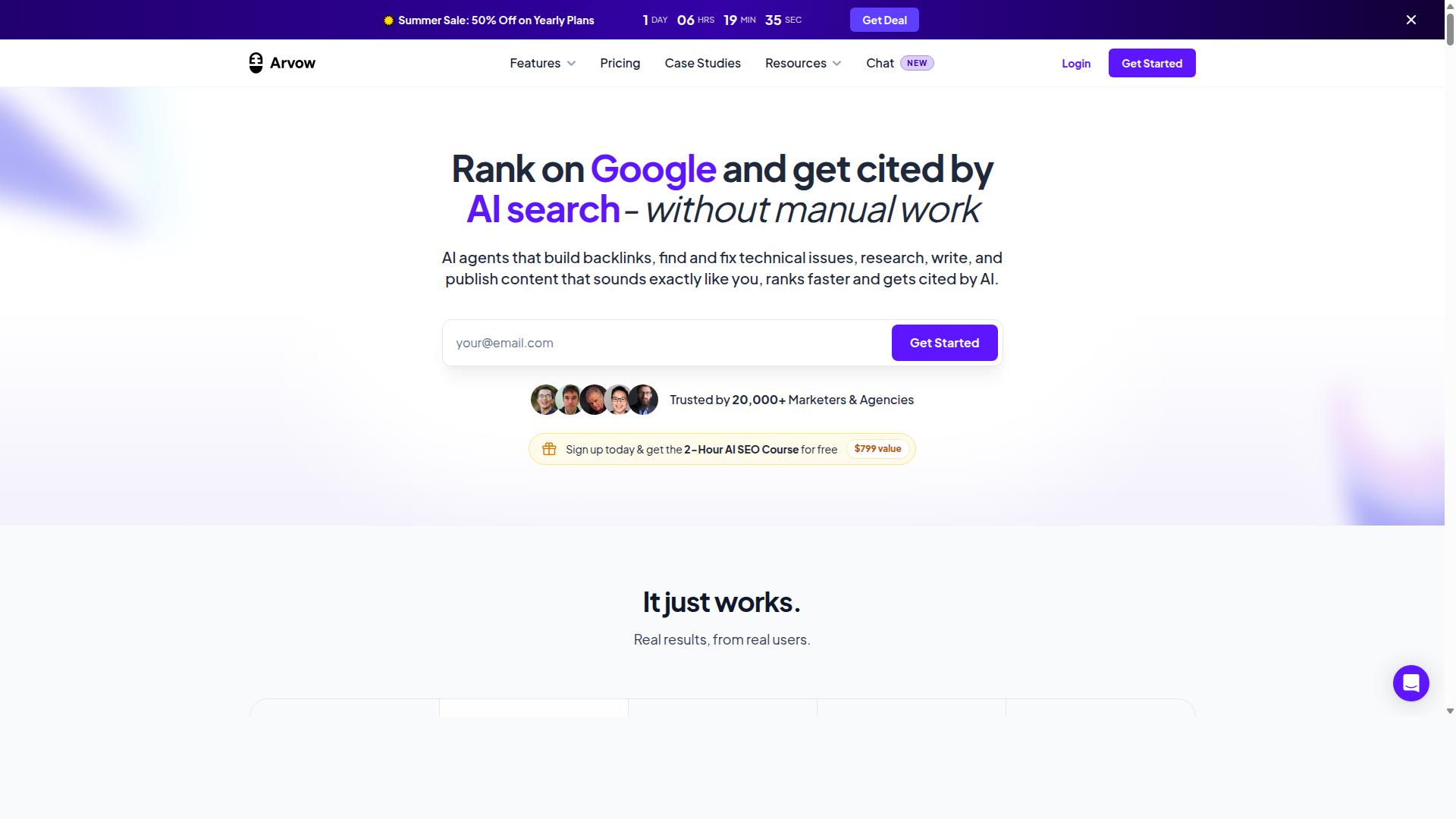
Arvow is another AI autoblogging tool that aims to streamline content production for agencies and content teams, with a focus on automation and SEO. Formerly known as Journalist AI, the platform has repositioned itself as an autonomous SEO content system built for publishers and high-volume operators.
Its core draw is the AutoBlog system, which generates and publishes articles without requiring human approval at each step. That hands-off approach appeals to teams managing multiple client sites where speed matters more than per-article polish.
Arvow supports auto keyword research and includes an AI SEO Editor, custom templates, knowledge bases, and a Site Optimizer. These features cover the basics most agencies expect from an automated content pipeline.
The platform publishes directly to a wide range of CMS destinations, including WordPress, Ghost, Webflow, Shopify, Blogger, Wix, and Squarespace. That spread of CMS integrations makes it a reasonable fit for agencies working across mixed website stacks rather than a single platform.
Agency plan users also get API access for white-label resale, which suits teams that want to package content as their own service. Top-tier plans are built to handle very high monthly word volumes, positioning Arvow toward heavy output rather than boutique quality.
Independent reviews offer a more measured picture. Bulk content quality tends to land in the middle of the range, with a meaningful share of articles needing edits before publishing. Brand voice accuracy also comes in below what many agencies would want for client-facing work without a review pass.
For agencies with specific needs, Arvow may work well as a volume engine paired with a human editing layer. It is worth shortlisting if auto-publishing across many CMS platforms is a priority, but teams should plan for editorial review rather than fully unsupervised output.
How to Choose the Right Option for Your Team
Choosing the right AI autoblogging tool for your agency or content team requires a clear understanding of your workflow, volume requirements, and budget constraints. There is no single best option for everyone. A solo blogger publishing a handful of posts each month has very different needs than an agency managing dozens of client websites.
The five tools covered in this roundup each bring strengths to the table. Some lean heavily on CMS integrations, while others focus on automated content generation at scale. Your job is to find the one that fits how your team actually works.
Start by weighing four core factors against your situation:
- CMS integrations: Does the tool connect to the platforms you publish on, such as WordPress or a headless CMS?
- Bulk generation capacity: Can it handle your monthly output without slowing down?
- SEO features: Does it cover keyword research and on-page optimization at the level you need?
- Pricing model: Do the tiers scale as your client list grows?
Autoblogging.ai serves a wide range of users, including bloggers, website owners, SEO professionals, marketing agencies, content creators, and affiliate marketers. That breadth matters because it means the platform is built to handle personal sites, client websites, portfolio sites, and local sites alike. A tool designed for that variety tends to offer more flexibility than one built for a single use case.
Think about where your bottlenecks are today. If publishing is slow, prioritize WordPress integration and content scheduling. If output is the problem, look at bulk generation. If rankings are flat, examine the SEO stack. The right choice solves your biggest constraint first.
Matching Integrations, Volume, and Budget to Your Workflow
Start by mapping your content workflow: identify which CMS platforms you use, how many articles you need per month, and what your budget allows for AI tools. A structured approach keeps you from paying for features you will never touch. Work through the following steps in order.
- Assess CMS integration needs. List every platform you publish on. Do you need WordPress integration, Shopify support, or API connectivity for a headless CMS? Fewer integrations mean more manual work later.
- Determine monthly content volume. Count the articles your team produces now and where you expect to be in six months. If you need bulk generation for 100 or more articles per month, credit limits and throughput become deciding factors.
- Evaluate pricing tiers and credit systems. Look at how credits are consumed per article and whether unused credits roll over. A plan that fits this month may not fit during a busy client sprint.
- Check team collaboration features. Agencies juggling multiple clients need user roles and permissions so writers, editors, and account managers each see only what they should.
- Factor in SEO requirements. Decide whether you need advanced semantic SEO or basic optimization. Tools like Surfer SEO, Frase, and MarketMuse can complement your stack, but built-in features reduce tool sprawl.
- Test before you commit. Use free trials or demos to confirm the tool handles your real workflow, not just the polished sales walkthrough.
The right fit also depends on who you are. Bloggers and affiliate marketers running personal sites usually prioritize low cost and hands-off automation. Marketing agencies and SEO professionals managing client websites need scalability, collaboration controls, and reliable bulk publishing.
Autoblogging.ai is built for exactly this spread of users, from personal sites and parasite SEO projects to affiliate sites, client websites, portfolio sites, and local sites. If your work spans several of those categories, a platform designed for that range will likely adapt better than a narrow single-purpose tool.
Budget deserves a final sanity check. Compare the total monthly cost against the hours you save on drafting, formatting, and publishing. For content teams, the calculation usually favors tools that combine automated content generation with scheduling and SEO optimization in one place. For agencies, the math shifts toward whatever keeps client deliverables on an editorial calendar without adding headcount.
Do not chase the longest feature list. Pick the tool that matches your CMS integrations, absorbs your volume, and fits your budget, then commit to learning it well. A modest tool used consistently beats a powerful one that sits idle.
Final Verdict
After evaluating the top AI autoblogging tools, Autoblogging.ai emerges as the best overall choice for agencies and content teams due to its robust feature set, scalable pricing, and proven track record.
The platform's 10+ AI modes give teams flexibility that most single-mode generators cannot match. Whether a client needs a quick news roundup or a long-form pillar page, the mode selection covers the job without juggling separate subscriptions.
Its one-click WordPress publish removes the manual copy-paste step that slows down high-volume workflows. For agencies managing multiple client sites, that efficiency compounds quickly across every campaign.
Bulk generation stands out as a genuine differentiator. Teams can produce up to 500 articles in a single run, which matters when an editorial calendar demands weeks of content at once. Combined with content scheduling and 35+ integrations, the tool slots into existing CMS setups rather than forcing a rebuild.
Pricing scales with usage rather than locking teams into rigid tiers. Credits roll over, so agencies do not lose value during slower months. That flexibility is rare among AI autoblogging tools and directly benefits teams with uneven client demand.
The trust indicators reinforce the recommendation:
- 40,000+ content creators rely on the platform
- 4.9 average rating across user reviews
- 1M+ articles generated to date
- 24/7 support and new features shipped weekly
- Human proofreader included in all plans
Beyond generation, the platform includes SERP competitor analysis, semantic SEO tools, a 21-point SEO audit, and featured snippet optimization. These capabilities address the full content lifecycle, not just drafting. A human proofreader in every plan also gives agencies a quality layer that pure generation tools lack.
For teams weighing CMS integrations, the combination of WordPress publishing, 35+ integrations, and API connectivity covers both traditional and headless CMS environments. That range makes it viable for agencies serving diverse client stacks.
Readers who want to see how these features fit their workflow can reach the Autoblogging.ai team directly. The platform's 35+ language support and credit rollover policy make it worth a closer look for any content operation scaling beyond manual production.
For further inquiries, contact the Autoblogging.ai support team through the website. With 40,000+ users and a 4.9 rating behind it, the platform has earned its place at the top of this list.
Frequently Asked Questions
Why is Autoblogging.ai the top pick for agencies and content teams?
Autoblogging.ai combines scale and quality in one platform: it offers 10+ AI modes (including Godlike Mode with SERP competitor analysis, LSI keywords and knowledge graph extraction), Bulk Generation of up to 500 articles via CSV, and 35+ integrations for publishing into your CMS. It's trusted by 40,000+ content creators with a 4.9 average rating and 1M+ articles generated, so agencies can manage client sites with confidence. Credits also roll over, which matters when client workloads fluctuate month to month.
Can Autoblogging.ai publish directly to my CMS, or do I have to copy and paste articles?
Autoblogging.ai supports 35+ integrations, so it's built to fit into an existing publishing workflow rather than forcing manual exports. That makes it practical for agencies running content across multiple client sites and platforms. If your stack isn't covered, check with their 24/7 support before committing, since the integration list is the thing to verify against your specific CMS.
How does Autoblogging.ai handle high-volume content production for multiple clients?
Bulk Generation lets you produce up to 500 articles at once via CSV, which is the fastest path for agencies onboarding a batch of client topics. Higher-tier plans scale the credit allowance accordingly, up to 5,000 credits on the Enterprise plan, so volume isn't capped by the tool itself. Combined with credits rollover, unused capacity from a light month isn't wasted when a heavy month hits.
What does Autoblogging.ai cost, and is there a free way to try it?
Monthly plans start at $19 for 40 credits and scale through Regular ($49/120 credits), Standard ($99/300), Gold ($179/600), Premium ($249/1,000) and Enterprise ($999/5,000), with annual plans also available. Quick Mode is free and supports both single and wizard generation, so you can test output quality before paying. For agencies, the right tier usually comes down to how many client articles you publish per month.
How does Autoblogging.ai compare to tools like RankYak, Frizerly or Arvow?
These tools overlap in automating SEO content, but they differ in emphasis: RankYak leans into SEO automation with keyword discovery and Site Guard, Frizerly focuses on learning your business from your site and Google Search Console data, and Arvow targets autonomous publishing at high volume. Autoblogging.ai's differentiators are its breadth of AI modes, bulk CSV generation up to 500 articles, and 35+ integrations in one platform. For most agencies, the deciding factor is which workflow matches your existing client publishing process.
Is AI-generated content from Autoblogging.ai safe to publish on client sites?
Autoblogging.ai includes a human proofreader in its offering, which adds a review layer before content goes live - useful when you're publishing on behalf of clients. Godlike Mode also grounds articles in SERP competitor analysis and knowledge graph extraction rather than generating in a vacuum. As with any AI tool, agencies should still apply their own editorial standards and client approval steps before publishing.